
Forward To Fellowship - Part Two
A potential pathway to a world beyond predation

I think this may be a good opportunity to clarify that I am here sharing what I see – not what I believe, not what I think, but what I see. I am not interested in convincing anyone of anything or making arguments based purely on morality, reason, scientific or historical “fact”; although all of those will be utilized at some points, they are not the primary intention.
My role is simply that of a messenger – stating what I see to be possible, what works, and what’s real through the prism of one individual being’s perspective. Given that this is perhaps one of the loftiest descriptions of the world I am espousing, it feels important to offer this disclaimer here.
In my previous essay, Fellowship with All of Creation, I spoke of a potential reality that’s available to us – one where humans live in harmony with all of nature, including plants and animals. I presented a particular aspect of that harmony that may seem like pure fantasy to most. The aspect I am referring to is the total freedom from predation of any kind. This means that not only do we as humans no longer behave as predators to other forms of animal life, but animal life as a whole evolves past that instinctual programming.
This essay is about laying out a process that could potentially be a pathway to this material reality. It answers the question:
If we can evolve as a planet to the point where there is no longer the taking of sentient life for the purposes of survival, how would we get from where we are now to there?
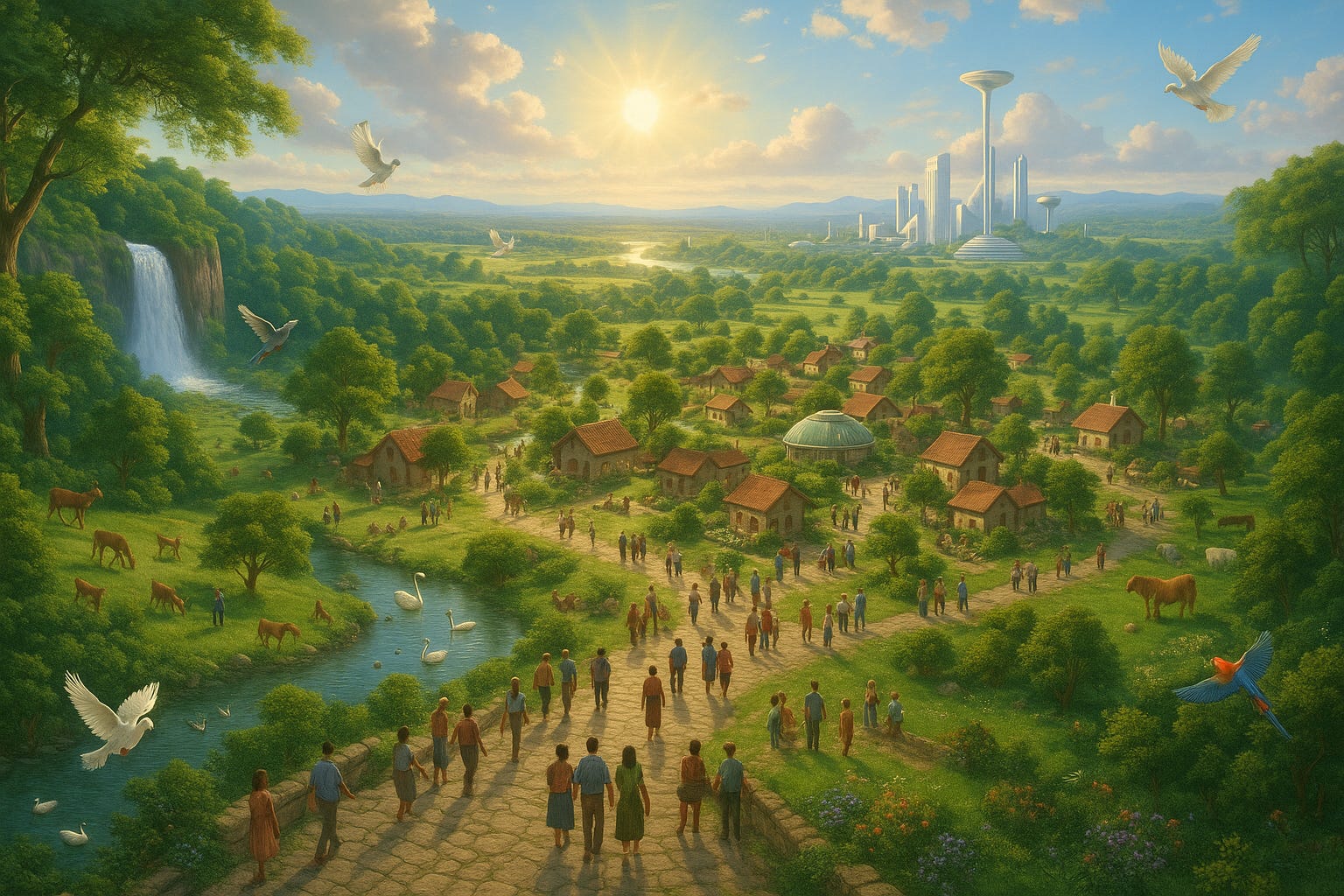
Reality as Vibration and Attunement
All of reality is expressed through energy in the form of vibration and resonance. To embody or inhabit any particular reality we would first attune to it vibrationally. To attune to it vibrationally, we can start by imagining and allowing ourselves to feel the effects in our body and psyche. By attuning to it, we are fixing our intention and energy to its existence, causing us to be magnetically pulled towards it – simultaneously revealing and clearing a pathway.
Addressing Suffering
We currently live in a world where suffering is commonplace, stretching to the extremes of our imagination. There are many approaches and things we can focus on that can greatly reduce our experience of suffering as individuals and as a collective, but in the previous essay I was mainly shining the light on the way in which we relate to other sentient animals.
We as a people are no strangers to responding to differences and conflict with fear, force, and destruction. We have long believed we are to overcome evil by destroying it, and that growth is achieved by diminishing – or taking from – another. Such behaviours spring from the illusion of separation, and by pursuing our aims in this way we perpetuate the very conditions we wish to transcend.
Conscious Creation of a New Reality
We are the conscious creators here – the players in the game of life who have become self-aware. Within our self-awareness lies the capacity to affect and alter the underlying patterns – the informational code – that defines reality itself. (We are the Very Source from which Creation Arises).
When we shift our consciousness out of the illusions of scarcity and separation, the physical world around us begins to reflect this change. Thus, by ceasing to participate in a practice – or even an industry – that systematically confines, subjugates, and kills other sentient beings, we foster a reality where this is less common in the wild and less present in the minds of those who seek power and control. We are the starting point; in each and every moment, there is the potential for pure creation.
So, what is the process?
Reduce Consumption
To begin, we look at where we are now. There is certainly much debate around whether or not eating animals is necessary for optimal health, and I am not intending to feed that debate here. I am operating from the point of view that we have the capacity to evolve beyond that need – even if it is present in our current physiology. Given the copious amounts of research done on this topic, it seems reasonable to conclude that some people appear to thrive without any animal products in their diet, while others seem to benefit from regular consumption.
What is equally clear is that the majority of people have not taken the liberty to explore that question for themselves. If each and every individual on the planet conducted a genuine, sincere assessment of whether or not their body presently requires meat – and, if so, how much – it would be revealed that we are already grossly overconsuming as a species.
By working with natural health modalities – such as Ayurveda and Traditional Chinese Medicine – and pairing them with blood-type awareness, other genetic insights, and listening closely to what best serves our bodies, it is likely that a large number of people would discover that they can live optimally with next to no animal products, if any. Others (especially those currently with deficiencies or other health issues) may still require some, yet far less than what they were consuming before. Here eating animals would function more as a short-term therapy, supporting healing and recalibration rather than forming a lifelong dependence.
Humanity currently consumes animal products in vast quantities largely because they enjoy the taste and/or believe it’s necessary. By shifting to eating foremost for health – while not sacrificing the pleasure of eating – we can still enjoy our food while greatly reducing the number of animals killed to feed us. My estimate is that with this step alone, we could almost immediately reduce animal production and consumption by upwards of 70 per cent.
Transformation
Right now, the vast majority of the world’s meat is produced in what are called factory farms – or CAFOs (concentrated animal feeding operations). We could begin transforming these into regenerative farms, where the animals are utilized for fertilization and pest management. Much of the land freed up would also be reforested, reestablishing natural environments and bringing greater balance to the collective ecosystem. Given that we would likely need only 30 percent of the animals going forward – until consumption is entirely phased out – we would allow as many animals as possible to live out natural lives. Those deemed necessary to kill would be processed and frozen, creating a reserve for future needs.
In these spaces, animals would roam and forage freely. There would be none of the common factory-farm practices – routine antibiotics, hormone injections, or the administration of other synthetic chemicals or “medications”. Animals would breed naturally, without any artificial insemination or any other violations of, or intrusions on, their bodily autonomy. Relating to animals in this context would, in turn, significantly improve the energetic or metaphysical imprint within the collective field of creation – more on this later.
Improving Relationships with Plants
An integral part of improving our relationship to animals is actually shifting the way we relate to plants. We are focusing on animals because the ways in which we exploit and subjugate them are more obvious, given that they are sentient beings who clearly suffer. Yet our relationship with them merely amplifies how we relate in general – not only to animals but to plants, other humans, and Earth itself.
We tend to see most things outside ourselves as separate entities to be treated according to what serves us, rather than as extensions of ourselves – not separate, but deeply connected and interdependent. Because we rarely directly witness the discord and imbalances we create in plants, we are prone to overlook them.
Plants may not have the subjective experience of a conscious observer with senses and a nervous system as animals or humans do, but they exhibit very similar natural tendencies. The drives toward survival and proliferation are alive in all expressions of life. Though a plant may lack a nervous system or pain receptors to have a subjective experience of the discomfort, its natural intelligence still perceives attack or offence and adapts to protect itself. Because of this, plants will develop defences by producing certain chemicals to ward off predators to prevent their demise.
What’s interesting and important to note is that, though the plants may exhibit these behaviours, they are not akin to the solipsistic or self-centred tendencies often only found in humans and animals. A plant would seldom defend itself to perpetuate its own existence at the expense of another or of its environment in the way that a human might.
For example, in parts of Africa the leaves of the acacia tree are eaten by giraffes and antelope. When browsing pressure is high, the trees will produce more tannins to deter further feeding. But, the trees are not in constant defence; when the giraffes and antelope reduce their consumption sufficiently, the acacias return to lower levels of tannin production. This suggests that the trees are not trying to wipe out “a predator” but to find balance within the surrounding ecosystem.
With this understanding, we could greatly improve how we balance with our surrounding environments. It is well documented that many of the plants we eat contain compounds that can be toxic to humans – e.g., tomatoes, beans, and certain greens. One could reasonably infer that the production of some of these toxins is directly connected to the ways we are not in harmony with our natural environment. As we modify, overproduce, immerse in artificial spaces, and monocrop many foods, it could be expected that these plants would develop stronger defences against our persistent pressures.
By contrast, if we lived in harmony with the plants around us – allowing them to grow naturally and cultivating environments that support that harmony – they would co-evolve with us, tending toward nutrient profiles that better meet our needs, provided we bestow them the honour and reverence they deserve, given their nature to serve the whole.
Conscious Physical Evolution
Using our understanding of epigenetics, we can infer that as we make different choices – not only in what we eat, but how we live: how much sunlight we take in, how we breathe, how we process information, and how we connect with nature – our bodies will literally change; the expression of our genes will change. Anatomically and physiologically, humans share many significant traits with frugivores (animals that consume primarily fruit), yet we have omnivorous traits as well and have adapted to also digest – and sometimes benefit from – eating meat.
When we eat meat, we engage genetic pathways that may benefit from that intake. If we reduce meat consumption and adopt broadly health-supporting practices, we support different patterns of gene expression. As we tap into the energy of the more subtle sources – deep, conscious breathing; sunlight; electrons in the soil through grounding; and foods rich in life-force energy (fruit) – we require less of the denser matter and energy fields associated with meat. We attune, as it were, to a more energetic realm rather than the purely physical and molecular.
Spiritual and Energetic Practices
The approach of conscious physical evolution is merely an offshoot of a greater mechanism at play. These changes that would occur epigenetically – and ultimately genetically over time – have their limits. They still operate purely on the physical, molecular level, which is only part of the picture. This slow biological adaptation is the material mirror of a deeper energetic process – a lagging reflection of shifts that begin in consciousness and intention.
The mechanism of genetic variation alone is not the pathway to a totally different expression of humanity. At our core, we are energetic beings – then electromagnetic, then atomic, molecular, genetic and cellular; consciousness is foundational, not genetics. We are created and sustained by what is held psychically – and therefore expressed physically – in the infinite, eternal quantum field.
Projections of organized experience arise in a field of pure creation, manifesting physically into perceivable and tangible forms. When we align our intention and attention with what is present at the subtler levels of creation, we can shift the very expression of the physical world. What we currently experience as predation and competition reflects disharmony, separation, and imbalance in physical systems, which can be shifted through the proper intentions.
In recognizing the state of our current shared environment and our role in creating it, we can acknowledge what is needed now while simultaneously calling in and aligning with a greater expression. As a collective, we would move through any distortions and misperceptions in our own hearts and minds concerning the plant and animal worlds. By finally recognizing our true relationship with them – one of stewardship, guardianship, and custodianship rather than dominion – we meet them energetically as equals within the whole.
This recognition would entail a grieving process: the grief and sorrow of truly observing the impact we have had on the entire animal kingdom and the natural world. Moving through those emotions, we arrive at an understanding of our shared kinship. Yet we also acknowledge a time of transition – a period in which some nutritional dependence on the animals persists. In this space, we come together in prayer, reconciliation, and gratitude for all those still giving their lives.
We come to recognize that we have created this situation in which the majority of farmed animals cannot survive independently in the wild, and in which we have become somewhat physiologically dependent on animal sources. Out of responsibility, we assist the animals in whatever ways we can to live a full life; and through prayer and intentional communion, we would be led to an energetic agreement of reciprocation.
In this, we make a devoted vow: to do whatever is necessary to bring about a world where animals are no longer used in such ways. We begin to act as true stewards – doing what is best for humanity, the earth, and the longevity of both – while honouring and serving the animals who still give their lives during this period of transformation and transition.
Within this vow of prayer and devotion to the entire animal kingdom lies a profound shift in how we treat and work with the animals on farms. At the same time, we would adopt ancestral hunting practices that connect our spirits with the animals of the wild. Like many Indigenous cultures, we would perform ritual and ceremony: praying for bountiful hunts, thanking the animals involved, and ensuring their spirits are honoured.
Some traditions included shamans going on vision quests to receive guidance on where to find their next hunt, while hunters themselves undertook strict ritual practices to ensure their purity of heart. During the hunt, they remained attuned for any signs that the agreement between man and animal might have changed. In this way, the Indigenous peoples treated their relationship with animals as a sacred covenant, doing everything possible to ensure that the animal’s spirit was willing to offer itself.
At the heart of all of these methods is the internal energetic field work. Our care for the billions of farmed animals, and our embrace of ancestral practices, arises from an awareness of oneness with All That Is. We remain open to inspiration on how to continue co-evolving with plants and animals, while choosing conscious evolution within so as to create bodies that thrive on purer sources of energy and minds that shape the external world into one that no longer demands the destruction of innocence for the survival of but one single species amid an abundant diversity of life.
In summary, throughout our evolutionary process, it appears some of us have come to partially depend on animal products for optimal health – whether purely physiological or psychosomatic. The material realm is a reflection of a greater consciousness evolving spiritually to know and express more of itself as One. In recognizing both ideas, we can become aware of our present actions and envision what might be possible through conscious intention.
By choosing to consciously relate to animals – and to all of nature – as one with us, we bring about balance and harmony to the collective field, reducing the need for competition, predation, and ultimately any practice that perpetuates separation. Consciousness then begins to express itself as one balanced system, experiencing and knowing itself in infinite ways that are conducive to deeper understanding, greater awareness, continued growth, and the realization of the unconditional love innate to all of Creation.
Wow, the part about total freedom from predation and animal life evolving past instinctual programming truly paints an inspiring, albeit incredibly ambitious, vision of terrestrial coexistence. What if the mechanisms for such a planetry shift, particularly the reprogramming of deep-seated biological imperatives across entire species, would require a level of emergent intelligence or collective conciousness far beyond what we currently model in complex systems, implying a truly quantum leap in planetary biology?